

The History of GB\C Pokémon ROM Hacking, 1990-2020
From San Francisco to Taipei, From Helsinki to Rio

The following is an online version of extracts from my own book “The History of GB\C Pokémon ROM Hacking, 1990-2020: From San Francisco to Taipei, From Helsinki to Rio”. The latest update of the book can be found on this page.
Chapters:
Chapter 1: The Beginnings of ROM Hacking, 1990-2000
Chapter 2: The Pioneers of Pokémon Hacking, 2000-2009
Chapter 3: The 2nd Generation of Hackers and the Global Diaspora, 2009-2020
Chapter 4: The Great Re-Alignment, 2020-2024
Bonus Chapter: Women’s History of GB\C Pokémon Hacking
Appendix: GB\C Chinese Bootlegs of Pokémon, 1999-2003
Appendix: Adaptation History of Japanese Pokémon Green
Appendix: MissingNo.
Appendix: The PokéGods
Appendix: The Best GB\C Pokémon hacks of All Time
Bonus Appendix: The 2020-2025 GB\C Translation Renaissance
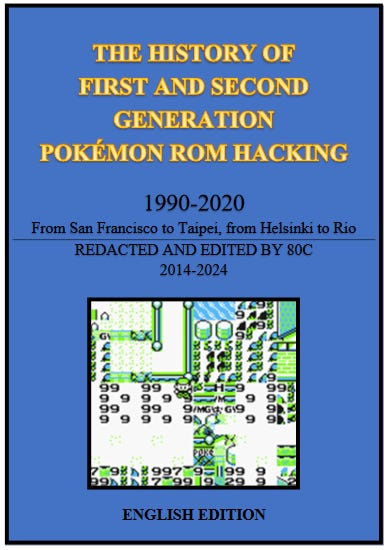
The downloadable version of the book itself is much more complete in that it features several dedicated sections and chapters on the topic. Among these, there is a comprehensive bibliography (alas, mostly made of lost web pages, which nonetheless I managed to preserve and document somehow), a glossary of ROM hacking, and authors index and, most importantly, it also includes encyclopedic sections containing most of the GB\C Pokémon hacks published between 1999 and 2020 (several hundreds) — including anything from celebrated ones to the most obscure and bizarre ones, on which I have personally put more emphasis in that the latter ones are seldom documented and, most of the times, not even documented or discussed at all, even though many of them had their share of relevance and influence.
Therefore, what is featured here online is the portion of the book devoted to the historiography of GB\C Pokémon ROM hacking (spin-offs included), comprising its “alternative” history, career analyses of the authors (both female and male), covering any geographical location possible on Earth.
The downloadable book is indexed accordingly, features page numbers, has way more images, gets updated more frequently (thus featuring more details and minor adjustments from time to time), and is also available in three languages (English, Spanish, and Italian). Each first page after the cover shows the current edition you are reading, so you will know in advance if your copy is up to date.
Prefaction: What this book is about and what it is not about
First of all, this book is the first serious and meticulous attempt ever at providing a comprehensive, non-institutionalized, non-trivial, and non-conformist History of a tiny branch of ROM Hacking, in turn a tiny portion of Youth Counterculture after the Fall of the Berlin Wall and the arrival of the User Net. Namely, this specific book is about tracking down ROM Hacking’s developments in the various scenes dedicated to GB\C Pokémon games — which were most of the times neglected but which, as you will get to know, will end up having tremendous impact on the whole of ROM hacking as time progressed (to this very day, too). This has been a monumental task that has lasted at least 10 years of research and direct involvement in the scenes, thereby assuring extreme familiarity with the topic in question.
After all, this major project was the extension of my encyclopedic works from the mid-2010s, therefore there was an urgent need to fill the gap of providing a unitary history of this subculture which was scattered all along the World and the world-wide web without any real unity and continuity — a gap that this book filled. Hardly anyone around was interested in keeping this history of their own (not even the authors) — which is too bad, considering how most of what gets written and published nowadays mostly has to do with the previous millennium, especially the last Century, of which I’m tired of (keep in mind my famous refrain from my musical works, “I don’t bother for the Twentieth Century”).
Secondly, being a non-institutional, non-corporate, and fully independent product made by an outsider, this book ended up being mostly a history of “alternative” hacks, obscure authors, and even more obscure fans and amateur developments – thus in stark contrast with the “summaries of the hits” circulating online, which tend to predominate this kind of discussions on the web, often with a serious (and at times deliberate) lack of knowledge. I was largely indifferent to what (little) great publishing and big household names had to say and write about: I did not write this history for them, I have written it for the fans of ROM Hacking (who have made and lived this particular history) and for Arts and Tech enthusiasts, for which I also provided Encyclopedias and Glossary (and so forth) for improved understandment.
Therefore, this history had to keep track of any development, not just the ones that are liked (even according to my personal biases, which are pretty much explained in the “my evaluation criteria” section of the “GB\C ratings” section). For much biases I might or might not have had (for instance, way less than many of my former colleagues do, I must add), I dared to change my personal assumptions to adopt an universalist, neutral stance whenever possible, thereby including and discussing (at length) even the currents and developments I did not like – and, surprise, even in those cases I managed to find relevant matter, thus changing my mind on more than one occasion and eventually re-evaluating things I previously neglected. Matter of fact, what little I knew about my subject in my formative years ten years prior was literally turned upside down, as my findings pretty much overturned any narrative and staple that was thought as being firmly established in previous public discourse and web chatter.
Now, in an age that proceeds in terms of copy-paste, paid press agencies, and echo chambers, I decided for a time to forget anything that was written beforehand and go on with my comprehensive extended research, without having an already prefabricated and ready thesis at hand, letting the conclusions to emerge only by the end of my research (i.e.: the contrary of the not-so-well-crafted fakeries that are in vogue now, especially in supremacist and reactionary circles and publications of these times). Therefore, this book also devotes itself to more obscure or overlooked experiences from the entire World, thereby documenting these developments in a near-universal way, as old proper old-fashioned books and research used to be before the age of perpetual crisis (and quarrel), when proper professional Encyclopedias and academic books did matter.
Lastly, this is also a book devoted to fun, in particular to that kind of non-hierarchical, non-organized, and non-monopolistic fun that used to be the common denominator of the whole of the youth before it got enslaved, oppressed, and brainwashed by major actors (corporations, politics, religious exponents, boring censors, algorithms, angry parents, etc., you name it), and is therefore also a history of how the means of production transited in the hands of the users, thereby blending that artificial barrier that there was between artist and public, between producer and consumer, between “top” and “bottom”.
In an age in which youth interest and activities are strictly regimented in a monopoly of time loss and distraction for the lucre of the aforementioned “major actors”, these experiences constituted the last gasps of that spontaneous vitality that permeated the youth spirit of the origins of the post-WW2 era that would be lost by the 2020s: ROM hacking was the true last chapter of the search of identity for the newest generations around, without the supervision and interference of the “grown-ups”. Realizing that by now I am about to get old, I wanted to bring a witness to this youthfulness to which I have contributed to since I was still a teenager, thereby offering a history of the youth written by the youth and for the youth – which is something that is all but lacking now, especially these days.
Good reading!